
The Budget module keeps a household's accounts from the bank's statements: you import the statement, the rules file what they know, and the plan tells where the month will end. A budget is shared with the people you invite, and the module is switched on in the modules settings.
The month at a glance
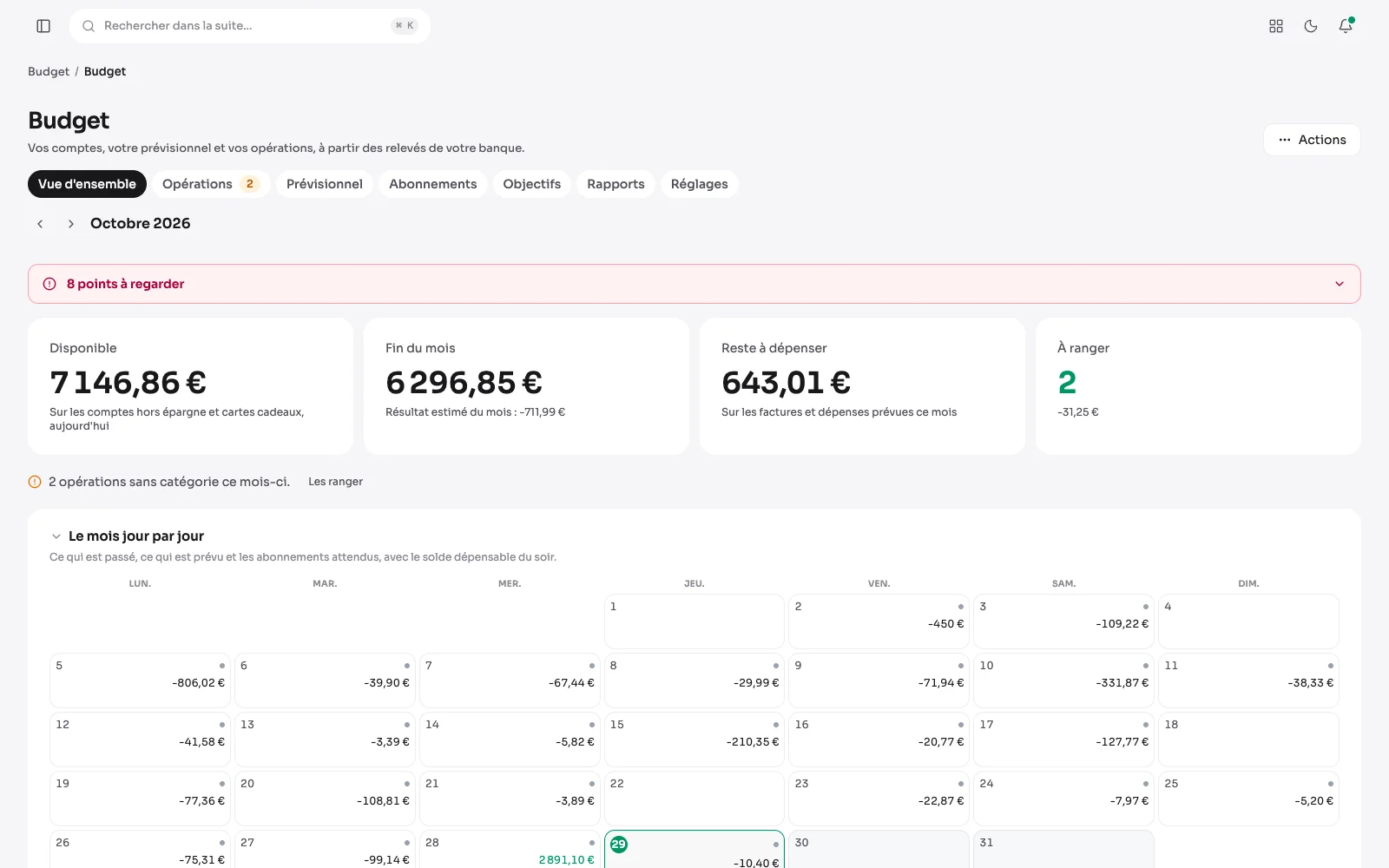
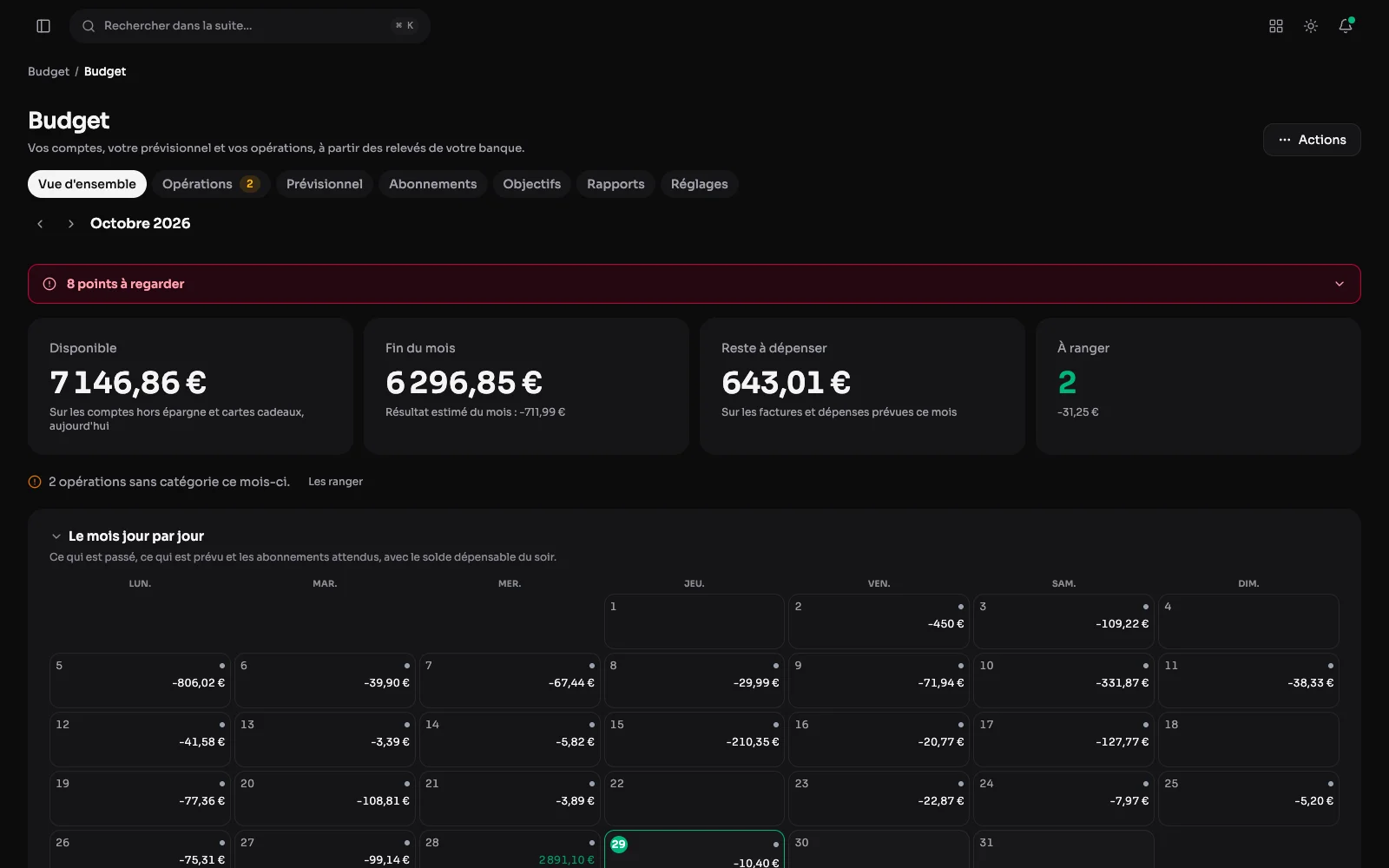
At the top, the points to look at, such as a category nearly spent, a payment that went through twice or an unusual expense. Then what you can spend today, the expected month's end and what is left to spend, and each account. Under the accounts, what the plan still expects: the accounts and that line make the month's end, to the cent.
The month day by day
A calendar of the month shows what has gone through, what is planned and the subscriptions expected, day by day. A click on a day gives its operations and the balance expected that evening.
The review of the month gone by
A finished month opens on its review: income, spending, savings and result, compared with the average of the six months before, the categories that went over the plan, the biggest expenses, the subscriptions paid and the share of income put aside.
The accounts, as a list or as cards
The accounts read as a list or as cards, as you choose, and the choice is kept. Below them, the month's end is given twice: on the money there is to spend, then with every account included, the savings, the gift cards and what the plan still puts aside.
Operations, day by day
Each operation of the month under its date, with its category as a pill: one click changes it. A planned operation waits for the bank, and the next statement ticks it off by itself.
Filing with one key
The operations nobody filed come one at a time. The learnt rule proposes its category: Enter accepts it, 1 to 4 take a frequent category, the arrow moves to the next one.
The bank's statement
You drop the bank's statement, as OFX or CSV; another bank's columns are set once. Before anything is saved, the preview says what is new, what ticks off a planned operation and what is already there, and the rules propose the category, down to the amount. An account linked to its bank no longer waits for a statement: it arrives on its own, every morning.
Accounts read every morning
An account linked to your bank is read every morning, by a provider licensed under PSD2, and what arrived is filed like an imported statement. Beside the account, the bank's balance next to the budget's, with a way to adjust the gap, and the payments still pending at the bank. A morning that brings operations says so in the bell.
Linking your bank
You pick your country, then your bank, and the consent is given at the bank itself: your banking credentials never pass through the site. The consent lasts as long as the bank allows, and the budget warns before it ends. Importing an OFX statement is still possible alongside.
Which account fills which
The bank gives its accounts, and for each you choose the budget account it fills, or leave it aside: an account that is not followed is never read.
The provider, set up once
In the site's settings, the provider is plugged in once and for all: the application's identifier, its private key, kept encrypted, and the return address to declare with them, with a step-by-step guide and a connection test. Each budget then links its own banks.
The plan, month by month
One row per category, one column per month: you type an amount in the cell, or repeat it up to a given month. A family folds down to its total, and the current month shows what is already done. Under each month, two ends: the balance it leaves on the current accounts, and the savings, with the passbook's interest in the month the bank pays it.
The plan against what happened
The plan also reads as actual or as gap: each cell then says what really happened, or how far the month went from the plan, in red when it goes over.
Subscriptions and contracts
The Subscriptions tab follows everything that comes back: internet box, phone, energy, insurance, platforms. It spots in the statements the payments that come back at the same pace, says what they cost per month and per year, warns before the deadline to cancel a contract that renews itself and drafts the cancellation letter.
Savings and credits
Savings goals with their progress, and credits with what is still owed, the monthly payment and the end date. The debt ratio is worked out from the budget's income. Total savings are what the savings accounts hold: what they hold outside any goal shows apart, and is given to the goal of your choice.
The reports
The month's spending as a ring, income, result and savings rate over twelve months, and the current account day by day: the solid line up to today, the dashes up to the expected month's end.
One shop in detail
In the reports, each shop the money goes to opens on its sheet: what it cost over twelve months, the number of visits, the average spend, the amount month by month and its latest operations. A rule can be created from the sheet.
What each category costs
Over the year, each bill and each expense: what is paid plus what the plan still holds, brought back to a month, with how often each one comes. As bars or as a table.
Rules that learn
Filing a bank operation by hand teaches its label: the next one will be filed the same way. A rule can also look at the amount: at the same shop, a small amount goes to restaurant, the rest to groceries.
A rule that splits
A rule can split an operation between several categories, in percentages: a hypermarket's purchases at 80% groceries and 20% home. It can also hold only between two days of the month, on one account or for one type of operation, and is tried on the last twelve months before it is saved.
The passbook's interest
A savings account can carry its rate: the budget draws an estimate of the year's interest from it, as a guide. The amount the bank really paid is noted on the account, and that is what the reports count.
Gift cards
A gift card becomes an account: its amount, the day it was received, its expiry date. Each purchase is noted from its line, counts in the month's spending and lowers the balance, without ever swelling what is available. Two months and then a week before it expires, a card with money left sends a reminder to the bell and by email.